
Leather
What You Need to Know
Everyone is familiar with leather, but few truly understand what it’s all about. Here are some insights to help you discover the fascinating world of leather
Choose Your Topic :
What Is Leather?
Leather is a material that has stood the test of time, continuing to shape our modern way of life. From prehistoric times to today, leather has played a crucial role in clothing, protection, and aesthetics.
Leather is created through tanning, a process that transforms perishable raw hides into durable, non-decaying material. This transformation is made possible by the expertise of tanners and curriers.
Without the dairy and meat industries, leather wouldn’t exist. Likewise, without the leather industry, hides would simply be waste to be processed and discarded.
By definition, only materials derived from animal hides through tanning can be called leather—excluding all synthetic or alternative materials.
Leather: The First Act of Recycling in History
The earliest evidence of leather use dates back to prehistoric times, with discoveries in Germany suggesting its use as far back as 300,000 years ago.
Early humans quickly realized that the hides of the animals they hunted could provide protection from the elements and predators. They used these skins for clothing and shelter, ensuring their survival in harsh environments. Over time, they also discovered that leather could be hardened by drying it near fire—an early form of material enhancement that paved the way for modern tanning techniques.
What Are the Criticisms Against Leather?
Leather’s animal origin sparks strong opposition from vegan advocates. Unfortunately, many misconceptions surround this material. It’s crucial to emphasize that no animal is killed for its hide—leather is a byproduct of the food industry, making it one of the world’s oldest and most sustainable forms of recycling.
With 300 million tons of meat consumed globally each year, incinerating or burying hides would be an environmental disaster. Instead, the leather industry repurposes these materials into durable, long-lasting products.
The criticism is especially unfair given that leather is a « living » material—a luxurious, highly sensory, yet incredibly resilient, breathable, and rot-proof fabric. Thanks to innovations, leather can now be water-repellent, machine-washable, printable, scented, and even stretchable, expanding its possibilities far beyond tradition.
Leather & Eco-Responsibility
Leather is an inherently eco-responsible material because it is derived from the upcycling of an existing byproduct. As long as the global population consumes meat, it makes sense to repurpose raw hides into the noble material that is leather.
By definition, only animal hides transformed through tanning can be called leather. This excludes synthetic alternatives, despite misleading terms such as “vegan leather,” “eco-leather,” or “vegetable leather” that have emerged in recent years. Ironically, many of these so-called sustainable alternatives are less eco-friendly than they claim, often relying on plastics or chemically intensive processes.
Misuse of the Term "Leather"
As mentioned earlier, leather is, by definition, derived from the transformation of animal hides (whether from land or aquatic animals).
While some alternative materials have made significant progress, they remain leather imitations. This applies to plant-based and vegan materials, which do not possess the unique characteristics of genuine leather.
Similarly, recycled leather is made by grinding leather scraps and mixing them with components like rubber or latex. The result is a highly processed material that loses the natural flexibility, grain, and prestige of real leather.
Most of these new materials were originally developed as alternatives to synthetic leather (faux leather), which is 100% chemical-based. However, many of these alternatives still contain a significant percentage of synthetic components, making them non-biodegradable.
A German FILK study found that none of these leather alternatives match the natural qualities of genuine leather in terms of durability, resistance to cracking, breathability, water absorption, or tear strength.
Nothing compares to real leather.
The Long Preparation Process
1/ The Action of Salt
Fresh hides are salted to remove moisture and slow down decomposition caused by microorganisms. Coarse rock salt (2–3 mm in diameter) is used, sometimes with antiseptic agents. During salting, hides can lose up to 10% of their water content. They are stacked to allow brine drainage in a controlled environment (humidity 70%–90%, temperature around 10°C).
After 15 days, the hides are desalted, inspected, and sorted based on thickness, defects, scars, weight, and surface area.
2/ The River Work
Once at the tannery, the hides undergo five key processes known as « river work »:
- Soaking (or rehydration): Removes impurities and dirt
- Hair removal/depilation: Eliminates hair and epidermis using a depilatory solution
- Fleshing: Mechanically removes subcutaneous tissue
- Bating: Uses enzymes to eliminate elastin and further clean the hides
- Pickling: The hides remain perishable at this stage, so they are acidified and salted to remove water, preparing them for tanning or preservation
3/ Tanning
Tanning is the most crucial step, transforming perishable animal hides into durable leather. This is achieved through tannins, which make the leather water-resistant and rot-proof. The two primary types of tannins are:
- Mineral tannins (chromium III, aluminum, zirconium, iron, etc.)
- Vegetable tannins (oak, chestnut, quebracho, mimosa, tara, sumac, myrobalan, etc.)
4/ Currying
Currying refers to post-tanning finishing operations commonly used in shoemaking. Specialized tools (bigorne, butoir, paroir, etc.) are used to refine the leather’s chemical and mechanical properties. Steps include:
- Wringing: Removes excess water for easier handling
- Sorting: Hides are classified based on surface defects
- Splitting and shaving: Adjusts leather thickness
- Re-tanning, dyeing, and conditioning: Alters firmness, density, color, and flexibility
- Second wringing or airing: Flattens hides
- Drying: Ensures the leather is completely dry
- Softening: Increases suppleness
5/ Finishing
At this stage, leather acquires its final texture and appearance, ensuring consistency across production. There are three main types of finishes:
- Aniline finish: A transparent coat enhances the leather’s natural beauty but requires careful maintenance. Over time, the color patinas and evolves.
- Semi-aniline finish: A lightly opaque pigment coat with a translucent protective layer, helping to conceal minor defects. Color also patinas over time.
- Pigmented finish: An opaque pigment layer makes the leather water-resistant and easy to maintain.
This meticulous process ensures high-quality, durable, and aesthetically refined leather, preserving both its natural properties and luxurious appeal.
What is Vegetable Tanning?
Tanning is the process that transforms raw hides into leather. Tannins make hides rot-proof and durable. Vegetable tanning is the most natural and oldest method: it uses plant-based tannins such as bark, leaves, or berries. It also allows the leather to be dyed, much like natural dyes do with fabrics.
A material produced using this tanning method is not a “vegan alternative to leather” because it still comes from animal hide—only the tanning process itself is plant-based. It should not be confused with leather alternatives made from plant fibers, which cannot legally be called “leather.”
Vegetable tanning is a more eco-friendly alternative to conventional chrome tanning. It is non-toxic, 100% biodegradable, and primarily uses natural ingredients (bark, fruit husks, plants), unlike conventional tanning, which relies on petrochemical and synthetic components.
The Two Main Types of Leather
Full-Grain Leather: The Best Quality
The grain represents the outermost layer of the hide, essentially, the epidermis. It produces premium leather, known for its durability, flexibility, and softness.
Full-grain leather retains the densest fibers of the hide, making it the most resistant and long-lasting type. Since it preserves the natural surface, it often displays unique wrinkles, scars, and natural marks, giving each piece a distinctive character.
(Corrected Grain Leather: Some leather undergoes light sanding to create a more uniform surface. However, this process removes the leather’s natural texture, softness, and durability over time)
Split Leather (Suede & Coated Leather)
Split leather comes from the inner layer of the hide (the « flesh side ») after a thick hide is split into two sheets. This allows manufacturers to double the usable leather surface.
Compared to full-grain leather, split leather is rougher, stiffer, and lacks the same durability. It is often processed into suede or covered with a coating to mimic the look of full-grain leather.
NUBUCK, SUEDE: SUEDED LEATHER
Nubuck, suede, and sueded leather—what’s the difference?
In stores and online, these terms are often misused, making it easy for beginners to get confused. Let’s clarify:
SUEDED LEATHER (also called suede)
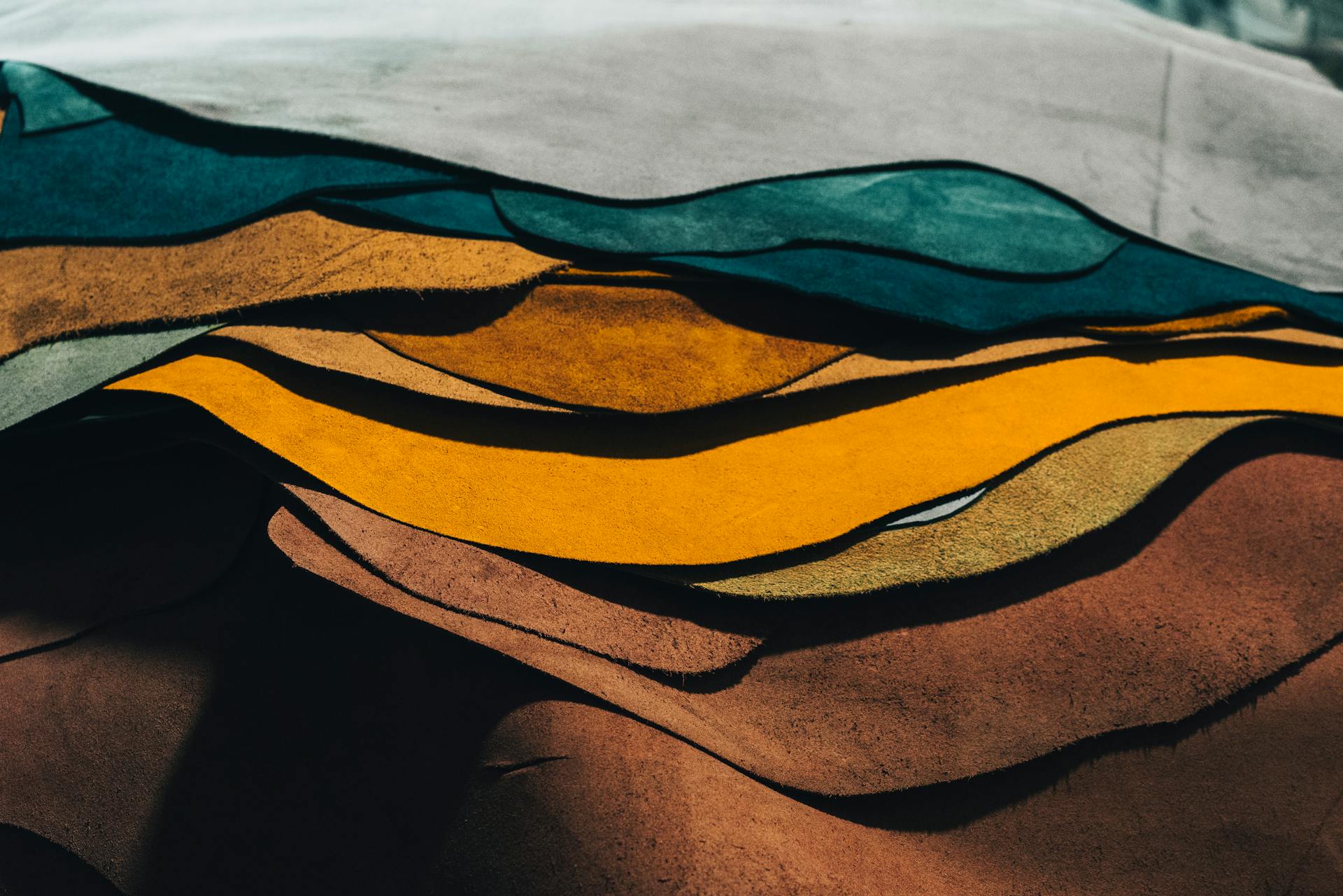
This is not a specific type of leather but rather a general term that refers to any leather that is not used on its « full-grain » side (the smooth outer surface). The term « suede » (pronounced « sweid ») comes from an anglicized version of the French word suède, which refers to a soft, brushed leather surface. It is often translated as « suede » in English.
SUEDE
While suede originally came from the hide of a deer (daim in French), today, this term is used more generally. A suede product simply refers to leather that has a textured, velvety surface rather than a smooth, polished finish.
NUBUCK
Nubuck is a full-grain leather, but instead of using the flesh side, it is the outer side of the hide that has been sanded and brushed to create a velvety, soft texture. If lightly sanded, the natural grain of the leather remains visible. Well-conditioned nubuck has a smooth, waxy feel, sometimes referred to as a « candle touch. »
In summary, suede is a broad term that includes both suede leather and nubuck. When derived from full-grain hides, these leathers are selected for their quality, finish, and luxurious appearance. They are soft, supple, and more comfortable than smooth leathers.
Is Sueded Leather Fragile?
There are many misconceptions about sueded leather. It is often believed to stain easily, wear out quickly, and require excessive maintenance.
MYTH: « Suede is Ruined by Water »
Think about how leather is made—raw hides go through extensive cleaning and a tanning process that preserves and strengthens the material. This process involves submerging the hides in water for hours or even weeks! For this reason, sueded leather does not fear water. However, it is susceptible to grease stains and general wear over time.
While sueded leather is not inherently waterproof, it is also not destroyed by water. That’s why treating it with a water-resistant finish can help enhance its durability.
Sources :
https://fr.wikipedia.org/wiki/Cuir https://conseilnationalducuir.org/ https://leatherfrance.com/